Hierarchy
Authors, works, and subworks are connected as structured units.
The new digital Index is not simply a reproduction of the last printed edition with its addenda. Its internal structure has been rethought and sementically encoded so that relationships previously visible only to human readers can now be recognised, searched, and processed by the computer.
Authors, works, and subworks are connected as structured units.
Dates in the aetas column were converted into a machine-readable format.
They are segmented into author, work, and location within the new digital TLL
It will be possible to explore the Index through genre metadata.
The printed Index is one of the essential tools of the TLL. It identifies authors, works, chronological information, citation forms, and reference editions. The previous digital version of the Index largely preserved it as a graphical transposition. Indentation, typography, and layout remained meaningful for users, but not for computational processing.
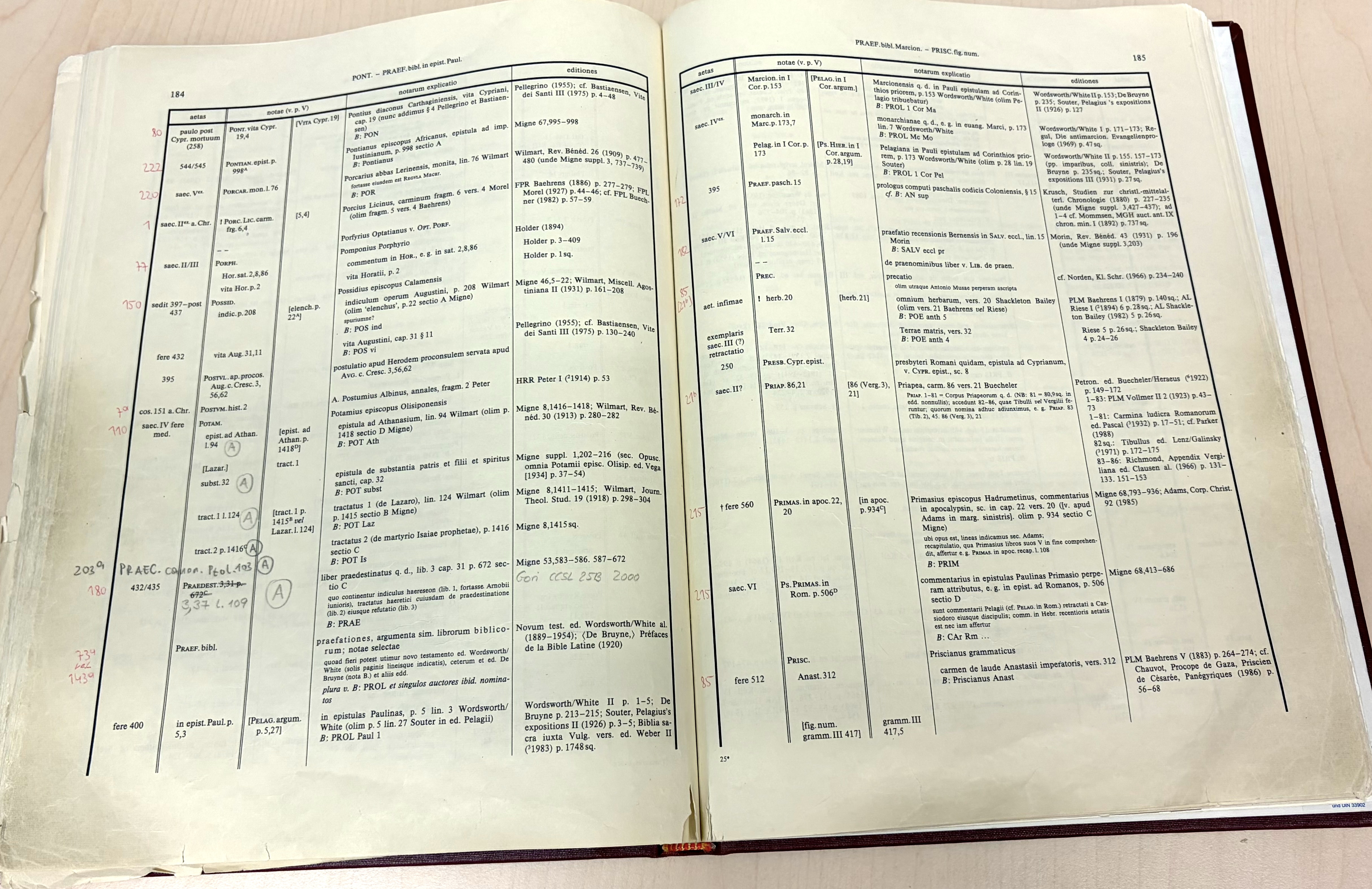
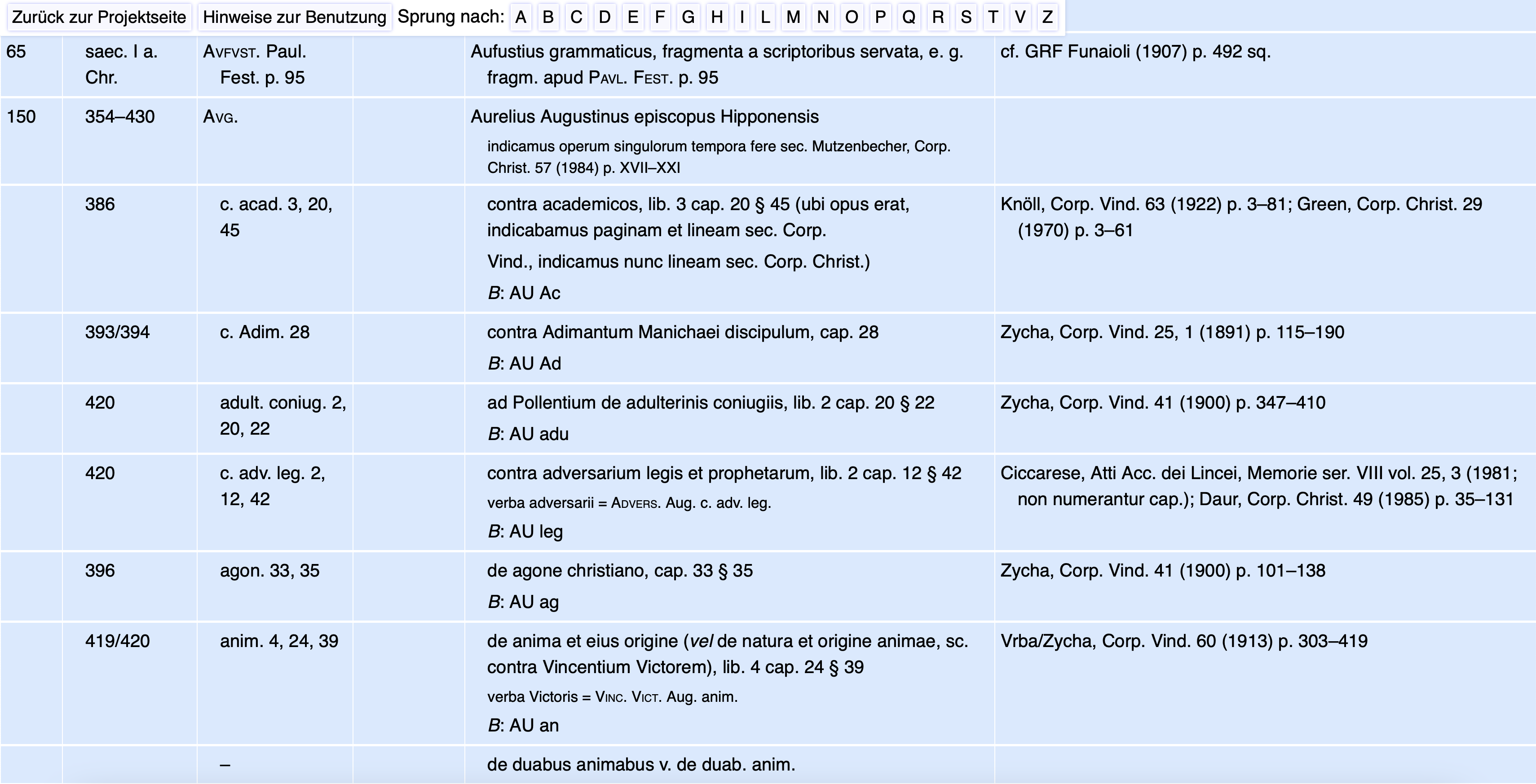
It defines the structure of the tool: authors, works, and subworks are encoded as meaningful entities rather than displayed as table rows.
Il permet à la page de réagir aux recherches, de préserver et de rendre visibles les relations de dépendance, et d’ordonner les entrées chronologiquement.
It makes the encoded structure legible through indentation, colour coding, spacing, and a clearer interface for consultation.
In the printed Index, hierarchy is often communicated through indentation. For example, a work may appear beneath its corresponding author. While in the previous digital version the two entries were not structurally related, in the new version these dependencies are made explicit through the use of attributes within the HTML structure.
<tr>
  <td><u>Ablab.</u></td>
</tr>

<tr>
  <td>epigr. 2</td>
</tr><tr id="ablab." class="group">
<td><u>Ablab.</u></td>
</tr>
<tr class="group">
<td><p class="work">epigr. 2</p></td>
</tr>In the new digital Index, users can still navigate through the alphabetical bar, now fixed on the left side of the interface. Additionally, they can also perform textual searches (case- and u/v-insensitive) either across all columns or within a specific one. Search is no longer reduced to simple linear matching: when a query matches an author, work, or subwork, the system reconstructs and retrieves the relevant context.
Aug.
rhet.
Cassiod.
rhet.
Apic.
exc.
pim. p. 87, 22
Since the chronological information contained in the aetas column has been transformed into a machine-readable format, results can now be ordered chronologically. It should be noted, however, that this ordering does not reflect the sequence in which citations appear within the TLL articles, since the dating provided by the Index does not necessarily correspond to the authors’ actual lifespan.
Avg. 354–430
Cic. * 106, cos. 63, † 43 a. Chr.
Ivl. Rvf. saec. IV?
Cic.
Ivl. Rvf.
Avg.
Avg.
Ivl. Rvf.
Cic.
The semantically enriched Index, which will soon include a genre-based filtering option, is conceived as part of the broader digital infrastructure of the TLL currently under developed at Sapienza. By modelling hierarchy, chronology, citation patterns, and genre metadata, the new encoding supports automatic citation recognition, structured search, and new forms of philological and linguistic research. The goal is not simply to digitise a reference work, but to transform it into an interoperable scholarly research environment.